






















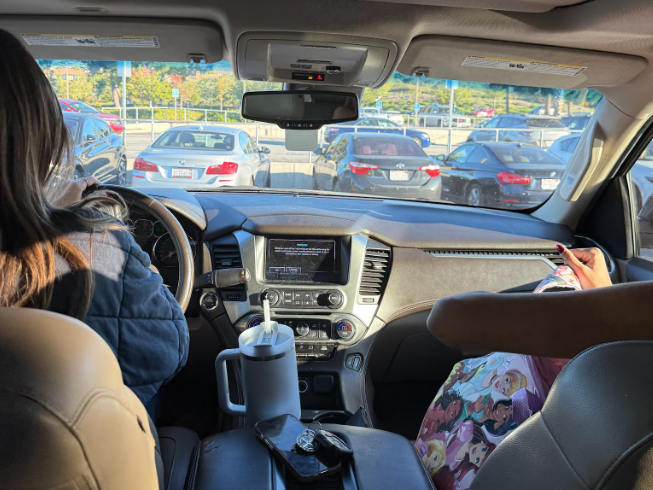
After school, practice, or almost any long period of social interaction with peers, many of us find ourselves in a similar state. We go straight to our cars, close the doors, and just sit there. The engine may be off, music on volume one, phone in our hand, or nothing going on at all. From the outside and at first glance, this behavior only looks unproductive, but beneath the surface, it is a moment of pure stillness that serves an important purpose we don’t even realize.
From a psychological perspective, sitting in our cars allows us to experience a transitional period between different environments, and this period is commonly referred to as a “liminal space.” This is the duration of time between two types of roles or states. All throughout the school day, we students are mandated to engage in our surroundings in countless ways: academically, socially, physically, and even emotionally. Our brains are nonstop working, constantly processing millions of pieces of information and stimuli at once while also regulating behavior, and when our day ends, the brain does not immediately turn off. Similarly, sitting in the car allows the nervous system to gradually mellow and relax rather than abruptly transitioning into another set of expectations and norms elsewhere.
This common behavior is very closely related to the autonomic nervous system, particularly the change from our fight-or-flight response to our rest-and-digest response. Right when we enter the car, it is the silence, familiarity, and physical stillness itself that directly signals safety to the brain, then releases endorphins to the body. Because of this, our heart rate begins to drop, and both noticeable and unnoticeable tensions soften. This is exactly why even a few minutes of doing absolutely nothing can feel surprisingly rejuvenating and restorative. Hope Edwards (12) reveals, “I don’t even realize I’m doing it the majority of the time. I’ll just sit in my car after my practice and honestly stare at nothing. Realizing it now, I see that it’s the only part of my day that I have time to truly process everything.”
There is also a strong emotional aspect that explains why most of us have a habit of sitting in our cars after school or any event. School and most any other social environment require constant self-awareness and self-monitoring, including how we speak, how we act, and how we are perceived. Sitting alone without company in the care removes that specific need for any sort of performance. This concept is what psychologists refer to as “cognitive offloading,” where the brain is finally allowed to process unresolved thoughts and emotions without any interruption. As a result, we mostly end up scrolling on social media, listening to music, or simply staring blankly, as a way to regain our emotional middleground. Adding on, Calista Nguyen (12) shares, “The time I have in my car is my reset button, and I can actually take a breath before moving on with my day-to-day life. I actually get excited to get my alone time in my car after I do something.”
Though this common behavior is unconventionally beneficial, it clearly reflects how demanding our days have become, especially mentally. The strong desire for decompression and the feeling of letting loose highlight that students carry significant loads of emotion that don’t seem to disappear right away. But, the next time you sit in your car after everything is over, just know that you are not being lazy, only preparing yourself to move forward most peacefully.