







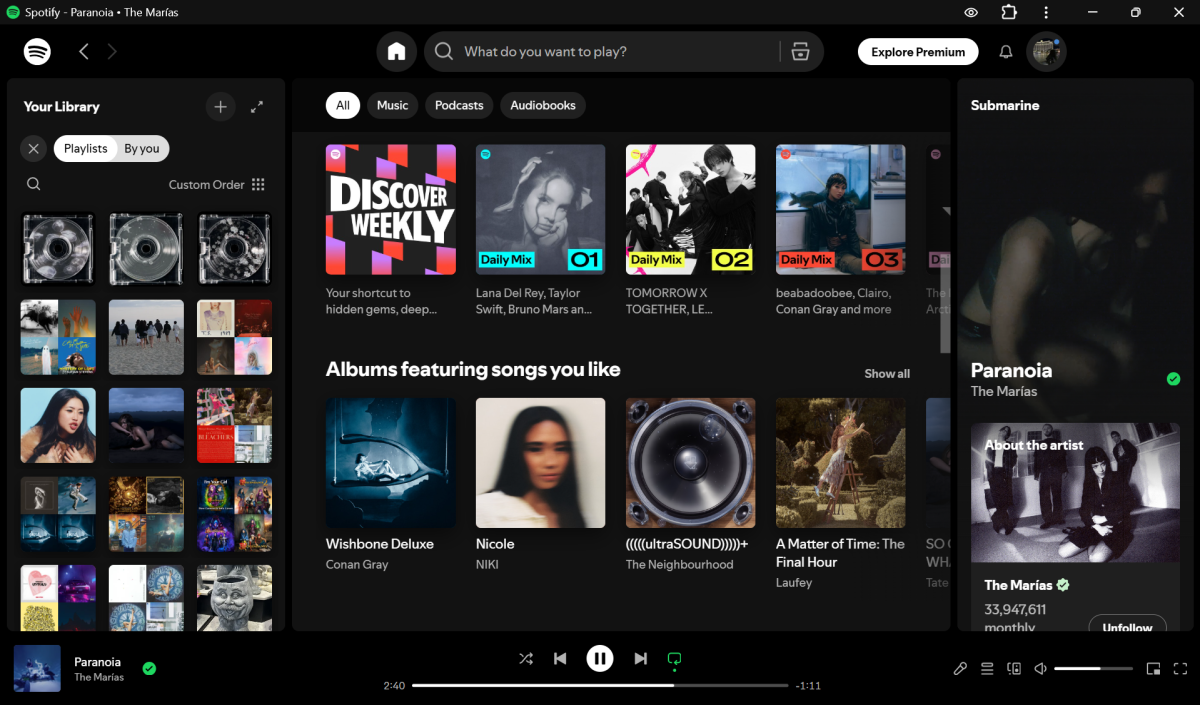











Headphones, wired earbuds, and AirPods – these are all electronics that the students of today find necessary to bring on campus. For the period of hormones and emotions, music has been an outlet for teenagers to truly connect with their emotions, and it is not a solution that exists purely in adolescence, either. Music is an art form that has been uniquely amplified in the modern age of technology, becoming an easy-access form of comfort and display of emotions for unique situations. Channeling these complicated emotions becomes simple through one integral part of music: playlists.
Every released song and album may have a designated theme or storyline, but the true freedom comes in dissecting all matters of different artists’ works to create a playlist especially for you. To gain a teenage perspective, Sage Li (11) reiterates a similar sentiment, sharing, “Making different playlists allows me to feel different emotions to the fullest. There are some songs that depict my mood perfectly, and putting similar songs into one single playlist has a grounding effect and makes me more present in the moment.” Making playlists is in itself an art that acts as a personal mosaic.
An article from Medium highlights the variety of psychological effects a playlist can have on somebody. Personal and social connection both can be found with music and shared playlists as a medium. The playlist, in isolation with the listener, can still have an impact, too. As they can be very raw reflections of one’s emotion, playlists can evoke nearly any emotion, even blends of them when the situation calls for it. They have also been shown to be a form of motivation as the right playlist can enhance concentration, memory, and creativity. Ultimately, the magic of a playlist lies in its flexibility and effect, and its customizable nature makes music a dear form of art for the human soul.
The importance of these effects is further highlighted in an article published by the Glendale Library, Arts & Culture. This work states that music’s most important function is its ability to develop the feeling of cohesion. Specifically, music’s repetitive and rhythmic nature is noted to engage the neocortex in the brain, causing the brain to calm and reduce impulsivity. Music almost acts like a medicine in the way that it can reduce blood pressure, anxiety, and pain. Emma Wang (11) states how in the process of building a playlist song by song, she feels “a sense of satisfaction whenever two songs connect perfectly. Then, if it continues, I feel an odd sense of accomplishment even if the playlist may not have the happiest of songs.”
Although it may not be the solution for extreme cases, the ability to combat anxiety and depression makes music highly valuable and a gem in the human experience. Not to mention it can be used as an indicator for poor mental health as the National Library of Medicine describes a correlation between mental health and genre of music. Not only can music taste be an indicator for mental health, but it can directly impact it to create benefits such as a positive attitude. These traits of such an integral part of most people’s lives is what exemplifies the charm of music, and especially playlists, which allow the user a customizable experience that allows them to be in control of their mood and health.
Essentially, even with its origin shrouded in mystery, music has crept into human life, entertainment, and culture. Its existence shapes the lives, hearts, and souls of many and continues to develop genres that will continue to impact the cultural and entertainment sphere. This love letter to playlists serves as a thank you for every song combination that lifted the burdens of many and the memories that can be stored in one collection of songs.

