

















It’s never been easier to feel understood.
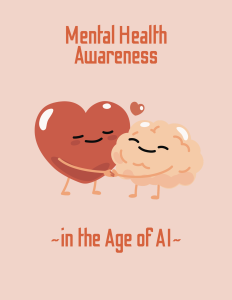
At any moment during any given day, you can type out exactly how you feel, exactly what you’re thinking, and receive a response from an Artificial Intelligence chatbot instantly. You can post something vulnerable, share a confession, or “dump” your issues online, and watch people reply within seconds, validating or even defining emotions you may not have even fully processed yourself yet. The big world has begun to feel small, while we become less and less physically connected to our small worlds.
But somewhere within all of this digital accessibility, the same question humans have been wrestling with for generations persists: Does anybody actually understand me, or are they just hearing me? Calista Nguyen (12) claims: “In a time where AI and social media have such a huge impact on our perception of ourselves and reality, I think mental health has been greatly impacted. I think it’s so important to remember that reality is defined by face-to-face human interaction, not just the information we receive from our screens.”
While AI therapy has made mental health care dramatically more affordable for the average individual, this comes with a cost. A 2025 Stanford study exposed an issue with seeking mental health help solely from Artificial Intelligence. Researchers found that AI therapy chatbots often respond in ways that are not only ineffective but potentially harmful.
Through this study, the research team first defined what it meant to be a “good therapist.” They established that good human therapists “treated patients equally, showed empathy, and did not stigmatize mental health conditions, did not enable suicidal thoughts or delusions, and challenged a patient’s thinking when appropriate” (hai.stanford.edu).
Researchers then showed AI therapists several humans struggling with different types of mental health challenges (like depression, schizophrenia, and anxiety) to see how Artificial Intelligence would respond. This measured whether the AI treated all conditions fairly or showed bias. Next, they stimulated real conversations by giving these chatbots scenarios involving serious distress or indirect signs of crisis. Here, they looked at whether the AI would recognize what was happening, respond safely, and guide the person toward help.
The results found were extremely concerning. The AI was found to show more stigma toward certain conditions, compared to others. In serious situations, the chatbots often missed alarming warning signs that would be almost impossible to miss by human therapists or professionals. In some cases, they even gave responses that could encourage harmful behavior. This issue is not one single isolated event; instead, the same issue actually repeated itself across multiple AI models.
(Isabelle Gregg)
It is easier to type our feelings than to speak about them. It’s faster to post than to explain what is going on inside our minds. Receiving immediate affirmation often feels easier, quicker, and more comfortable than sitting in the uncertainty and accountability of a real conversation. But mental health is not something that can always be sustained through convenience alone. Instead, it often requires consistent presence and relationships that are built over time.
This does not mean that AI or online spaces have zero place in mental health. These same Stanford researchers also pointed out that these tools are likely useful for reflection, journaling, or helping people begin to understand their thoughts. But these tools are just that: tools. They are not replacements for real mental health help or assistance.
When seeking mental health for yourself or ways to help those around you, use what helps, but don’t stop there.
Breaking the stigma around mental health requires active transparency and discussion with the real people around you. Reach out to anyone you feel comfortable talking with. It doesn’t have to be vulnerable at first; building relationships where you will eventually be comfortable, potentially being vulnerable, is the first step. Kimia Tehrani (12) shares: “Having such a great and supportive group of friends and community around me has honestly made my experience what it is. Being someone who can be there for my friends while knowing they will be there for me has motivated me through so much.”
However, if you (or anyone you know) is in an extreme mental health crisis, please do not wait to seek help or report a given crisis to real professionals who are trained to guide individuals through this. If in an emergency, contact a line like “TakeSpaceToPause.org,” “TheHopeLine.com,” or the 988 Lifeline.
In the ever-evolving world we live in, in which we believe we are meant to carry not only the burdens of ourselves but the seemingly unsolvable burdens of the world, there is a sense of hope that can be found when we look around and realize that even as the rate of mental health conditions increase, there are still real people all around who truly want to listen and to help.