






















Although we probably never think about it, although it is likely something that just “happens” subconsciously, our senses heavily impact our perception of ourselves and the world. No, we don’t think about the feeling of our clothes, the sound of the noises our brains automatically filter out, or the scent of home and the rooms we have adapted to. Still, the tissue and the makeup of our brain’s sensory “areas” play a major role– actually a remarkable role– in our ability to function in a way that we recognize as “human.”
As humans, we naturally link visual and audio information. It is our instinct. It happens without thought. For example, the thought of watching a video in which there is a slight lag between the audio and visual content is almost painful. Our brains want to make it make sense. Our brains are programmed to create connections between these two sensory inputs. This idea that audio and visual (sensory) information connects to our thought process as humans introduces the notion that the ability to see, smell, hear, feel might actually contribute more to daily functions— like simply thinking– more than we think.
The converging of our senses is shown through the functioning of our superior colliculus, where vision and hearing come together. However, shockingly, we have found that eye movements affect auditory signals even when not in this convergent structure, the superior colliculus. This idea suggests that our senses don’t operate in isolation or only merge at one “meeting point,” but are structurally coordinated to support attention and focus. Here, it becomes clear that vision can guide our other senses, meaning that where what we look at influences what we hear and how we process it.
On the Huberman Lab Podcast, Dr. Jennifer Groh, professor of psychology and neuroscience at Duke University, introduced this next concept: The Theory of Thought. This theory implies that all thought is merely a sensory “simulation” we create in our visual, auditory, and somatosensory cortexes. It presents the suggestion that perhaps, what makes humans more evolved, more “intelligent,” and more capable of innovation than other mammals is this ability to create these simulations; these thoughts.
For example, when we think of an object, or an idea, our mind instantly creates the visuals, the sounds, and the smells associated with the given object. When we’re thinking, we’re really just creating this sensory world within our own heads, that does not really exist outside of the context of our minds.
For instance, in Andrew Huberman’s episode, he is asked, “What comes to mind when you think of the word, ‘cat?’” Huberman describes a grey cat and the smell of its litterbox, showing that thinking of the idea of something is truly just creating a sensory experience in our own mind that matches up with this object we’ve encountered in the real world.
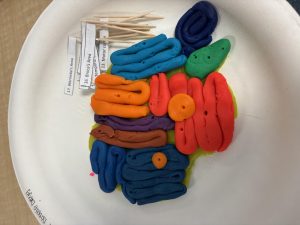
When asked the same question, Zen Bhayani (12) responds “I think of a little cat. It has whiskers. It is black, and has yellow eyes.” When he “thinks” of this imaginary cat, in reality, his visual cortex actively forms an immersive sensory image that matches his own perception and understanding of this word, “cat.”
(Isabelle Gregg)
Turns out, science backs this theory up. Surprisingly, humans have far more sensory tissue in their brains than any mammals, including monkeys. While our brains are extremely similar to those of primates, something that varies drastically is this amount of sensory tissue. If we see, hear, and smell no better than monkeys seemingly do, what is all this extra tissue for?
These sensory systems might explain how we think with such depth, how we constantly create these simulations using our complex understanding of our senses, and how we utilize them to plan, think, and innovate. Calista Ngyuen (12) says, “I found this concept beyond fascinating: The idea that our thoughts are primarily imagining using our senses. I still wonder what this means for the future of humans. Will our senses continue evolving, making our thought process more efficient and refined?”
Perhaps what makes us human is not simply what we see or hear, but our extraordinary and unique ability to turn sensation into thought, imagination, and meaning.