



















Take a trip down memory lane. When you were a kid and didn’t have a phone glued to your hand, what did you do when you were bored? Maybe you drew on random scraps of paper, built a LEGO city from your favorite TV show, or made up games just to entertain yourself. As children, we were naturally creative, and our imagination knew no limits.
But now, the second boredom hits, we reach for our devices. Instead of daydreaming, we scroll. Instead of thinking deeply, we consume passively. We have replaced imagination with stimulation, and the result is a kind of “brain rust.”
In today’s world, technology is on the rise. It is soaring, and every day that passes, it improves little by little. The most prevalent form now is artificial intelligence, and there is no doubt that it has changed our lives–for better or worse. It has changed our work habits, our understanding of the world, and our approach to everyday life. Rui Zhao (10) comments that “I think AI provides pathways of efficiency in studies and technological advancement. However, people have become overly dependent on it in daily life and often abuse the software, which is causing a decrease in emotional intelligence and human creativity.”
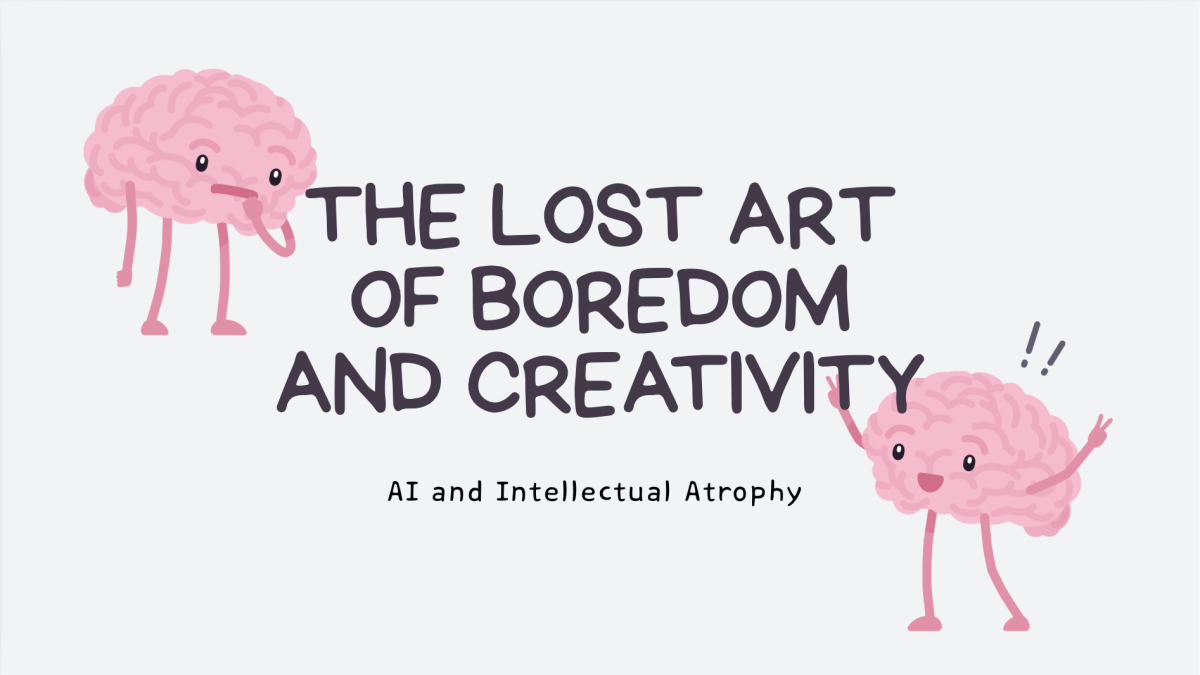
When we look deeper, AI is changing the way we think as human beings. When it is used incorrectly, which is very common, it leads to “intellectual atrophy,” and we may not even notice it.
In her TED Talk, Sol Rashidi, a technologist and business executive, warns that our “brains are rusting” because we have prioritized “quickness over quality” and “ease over experience.” We turn to technology to think for us, and when we do this, we slowly lose our ability to create, imagine, and solve problems.
She also points out how we are losing our “emotional quotient” and “social quotient,” which is the ability to read people and respond empathetically. In other words, our capacity to stay connected with others and even with ourselves is disappearing. This is another kind of creativity, an emotional and social one, that is being put at risk from the use of AI.
In order to combat this “brain rust,” Rashidi proposes four methods. First, we must know when to use AI and when to not use AI. AI was created in order to help improve the quality and efficiency of tasks, not completely do them for us. Therefore, we should use it when we are already proficient at something, not when we are learning something new. For example, when students use AI to write their essays, they lose their opportunity to learn and tell stories. However, it is acceptable for a teacher to use AI to enhance lessons for better student learning.
She also advocates for making common sense common again. This means to think critically and verify information instead of blindly trusting whatever AI returns to us. After all, AI is still a work in process and is not always right. That being the case, it is important for us to trust common sense, the very thing instilled in us from when we were children.
She also encourages less phone usage and more socialization. If there is one thing that AI cannot replace, it is our emotional and social intelligence. Constant screen time can lead to a loss in this skill, so by practicing engagement with real people, it strengthens neural networks and improves cognitive function.
Lastly, Rashidi emphasizes consuming less and creating more. Practicing deeper thinking and creativity gives the brain time to reflect. This could include journaling, daydreaming, or merely working without constant digital input.
Artificial intelligence is changing the world before our very eyes. While it can be a helpful tool, it can also be concerningly dangerous, and it is crucial for us to recognize how it is affecting us in ways that we don’t even expect. One such way is how we are losing the ability to think and be creative.
So the next time you are bored, don’t treat it as something bad. We value productivity so much in our daily routines that we forget to simply reset and do nothing. In these moments of boredom, we sit in silence and let our minds wander. Maybe in between all the chaos of the day, boredom is the one thing we need to bring our creativity back.
Mr. Walls (S) explains that “Boredom is the key to happiness and, for many people, success, in our lives. Boredom is to our brain what hunger and thirst is to our body. It is a subjective signal from our brain that it is craving stimulation, or more specifically, dopamine.” Dopamine, he says, is a neurotransmitter that tells neurons when to fire or not fire. It’s the chemical behind motivation and reward. “Things that give us dopamine are called ‘dopaminergic actions.’ The more we enjoy something the more we get dopamine.”
However, as he warns, “Not all actions produce the same amount of dopamine. Highly dopaminergic actions produce a lot of dopamine. TikTok, for instance, produces a ton of dopamine, more than our neurons have receptor sites for.” Over time, this leads to overstimulation and less natural enjoyment of everyday life. “Overuse of dopaminergic actions results in the rest of life feeling boring, and we enjoy things much less than we should. We also have less motivation, less awareness of emotions, less emotional processing power, and a cascade of other negative impacts.”
But there is hope. “The less bored you are today, the more bored you will be tomorrow. The more bored you are today, the less bored you will be tomorrow,” Mr. Walls says. “Learning to not just endure, but embrace boredom as a healthy state of being will see you enjoying just about everything else in your life to a far greater degree than you do now.”
Let’s preserve what is human and see where boredom takes us!
