




















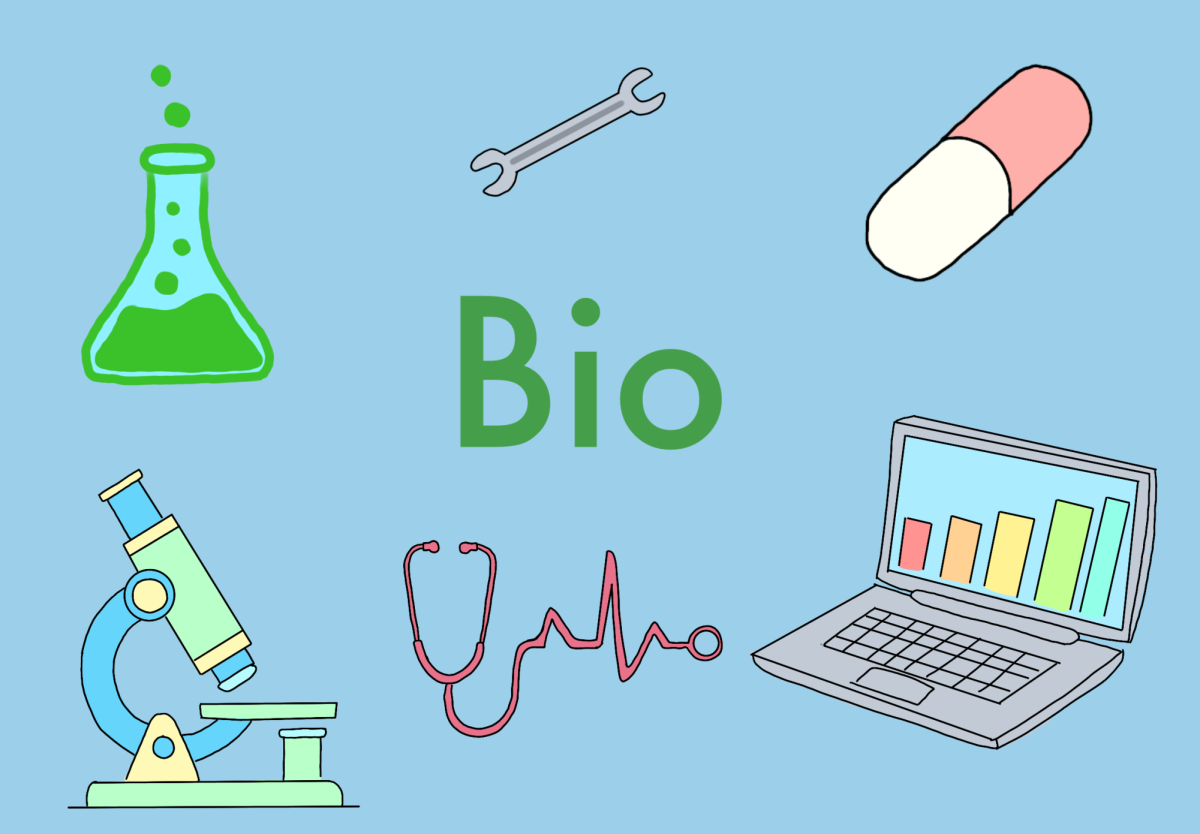
In the past, biology had been a simple study of living things in life. However, that boundary has now vanished, expanding and crossing over with all different types of fields. From combining technology and biology to a bridge between engineering and biology, the biology field has massively expanded throughout the years. There are many cross-over fields like biotechnology, biochemistry, bioengineering, biomedical engineering, and bioinformatics, which may seem confusing in terms of what each specific field does. Nevertheless, each field is different and unique, bringing discoveries that were once deemed impossible.
Biotechnology:
Biotechnology uses parts of living organisms and systems to develop technology and products to improve human life. Some examples of the use of biotechnology include GMOs, biofuels, and antibiotic production.
GMOs are a term used for foods that have been genetically modified by technology to become more resistant to pests and diseases. Biofuel is a renewable fuel from organic matter. According to the U.S. Department of Energy, “Microbes are being engineered with synthetic DNA to produce novel enzymes—special proteins that accelerate chemical reactions—that can increase the rate at which biomass is broken down. Microorganisms can also be modified to produce renewable hydrocarbon fuels that are identical to petroleum-based gasoline, diesel, or jet fuel,” showing how biotechnology is used in microbes to produce biofuel. Biotechnology can also be used in producing antibiotics by using genetic engineering. Genetic engineering modifies the DNA of microorganisms or uses CRISPR-CAS9 to increase the ability to produce antibiotics.
Some occupations in this field include research scientists, genetic engineers, and fermentation specialists. Research scientists conduct experiments to test new theories. They focus on molecular biology and cell structures. Genetic engineers use technology to manipulate the DNA of organisms, such as using CRISPR-CAS9 for gene editing. Fermentation specialists use yeast, fungi, or bacteria to produce products that are often used in the food industry, such as fermented food, beverages, and probiotics.
Mrs. Romero (S) had worked in the biotechnology field as a product manager under the marketing department, a job combining biotechnology and business. As a product manager, most of her time was spent on the computer rather than in the lab. She explained, “I would visit the lab to talk to scientists who worked at my company, or when I visited my customers in their own lab at their work site. My career transitioned from strictly dealing with science in a lab to business as a product manager. That’s when I went back to school to get my Master’s in Business (MBA) since I was dealing daily with business-related activities more than science.”
A product manager works five days a week from 8 A.M. to 5 P.M. Mrs. Romero also shares, “Sometimes travel was required to visit customers or promote the company at a trade show. It ranged from domestic travel to international travel. The longest I was away from home for a work trip was 11 days. I flew from LAX to Dubai, Dubai to India, India to Singapore, Singapore to Japan, and Japan to LAX. I literally flew around the world for my job! It was such a great experience to speak with other scientists about projects in their pipeline and share how my company could help them reach their goals. It was a thrill to experience other cultures and cuisines around the world…definitely one of the perks of the job. However, on a typical day, I would be at my desk working on my computer to answer emails from my sales team, customers, colleagues, and continuously problem-solving. Here and there, I would have company business meetings to attend with other departments regarding my product line. I was responsible for pricing products, inventory forecasting, budgeting, promoting my current product line, competitor analysis, new product development, product launch, etc. Product managers interact with every department at the company, so you learn quickly how to communicate effectively with many different personality types.”
Bioengineering
Bioengineering applies the principles of engineering to biological systems and creates products. Biomechanics, synthetic biology framework, and biocensors are all examples of bioengineering.
Biomechanics is a combination of biology and mechanics. It applies the mechanical principles to living organisms. As a subset of bioengineering, it mainly focuses on the mechanical aspects of biology. Synthetic biology redesigns organisms or constructs new biological devices. Additionally, based on NIH, “A biosensor is a device that measures biological or chemical reactions by generating signals proportional to the concentration of an analyte in the reaction.”
In the field of bioengineering, there are many jobs, such as synthetic biologists, biomaterials engineers, tissue engineers, etc. A synthetic biologist creates new biological systems and devices that do not exist naturally. As biomaterials engineers, they develop substances that can integrate with living tissues. Moreover, tissue engineers are scientists who grow tissues in the lab to repair damaged tissues.
Biomedical Engineering
Biomedical engineering is a branch of bioengineering that is solely focused on using engineering to develop medical products. It can include making products such as prosthetics or artificial organs.
With biomedical engineering, prosthetics are improving to become more natural and advanced, allowing users to have smoother movement and perform daily tasks more easily than before. South Dakota Mines states, “This field combines design, materials science, and medical knowledge to create devices that can significantly improve the lives of those who need them. Engineers use these principles to develop prosthetics that not only replace physical functions but also enhance the user’s quality of life by providing more natural and comfortable options.” Artificial organs use advanced materials, 3D printing, and tissue engineering to replace or support failing organs. Biomedical engineers are able to create compatibility by using biomaterials.
Occupations in this field can include rehabilitation engineer, medical imaging engineer, and clinical engineer. Rehabilitation engineers make technologies to assist those with disabilities. Medical imaging engineers create technologies, such as MRI machines, CT scanners, and Ultrasound machines. Mr. Nguyen (S) shares that MRI and CT scans change the way doctors look at patients by providing “a more in-depth image, which allows for more precise healthcare to be administered.”
Biochemistry
Biochemistry is the study of the chemical processes related to living organisms. Some examples of biochemistry are photosynthesis and protein folding.
Photosynthesis is a biochemical process that converts sunlight into chemical energy, which creates glucose. The light-dependent reactions and Calvin Cycle are biochemical stages. In simple terms, protein folding is where chains of amino acids fold into proteins. It is a biochemical process because it is driven by chemical forces.
Jobs in this field can include, but are not limited to, analytical biochemists, medicinal chemists, and toxicologists. An analytical biochemist tests chemicals in biological products such as drugs and toxins. A medicinal chemist focuses on drug molecules and how it bonds with proteins to stop a disease. Moreover, toxicologists study the effects of drugs and poisons on the environment to determine the dosage.
Bioinformatics
Bioinformatics is a crossover between biology, data science, and computer science, where algorithms are used to analyze biological data. Genome sequencing, sequence alignment, and predictive modeling are all examples of bioinformatics.
Genome sequencing is a laboratory method that determines the genetic sequence of living organisms, often used to find the cause of diseases. It can provide all types of data that can be analyzed and stored through bioinformatics. Sequence alignment is a bioinformatics method to compare two or more DNA or RNA strands and identify the similarities between them. Last but not least, predictive modeling is a technique that uses statistics to predict future events based on past data.
A few occupations in bioinformatics include genomics data scientist, computational biologist, and database administrator. As a genomic data scientist, they analyze data to find hereditary diseases or trace the evolution of viruses. Computational biologists build a computer simulation to predict how a drug will affect the human body. A database administrator manages the digital library where all DNA data is stored and makes it accessible and secure for researchers.
With these cross-over fields involving different specialties and techniques, they are more resilient to being taken over by artificial intelligence. Instead, AI will be used to enhance their job. Mr. Nguyen (S) agrees, “I believe biology can be helped by AI, but biology should be centered around the human experience and connection with the environment. All of these things cannot be accomplished with just AI.”
From using mechanical principles to build healthcare devices to analyzing data of genetic sequences, the field of biology has evolved to include not just the study of living organisms, but a combination of all different types of fields. Although each field may seem to serve a different purpose, all of them center around one goal: to improve the human experience.
