

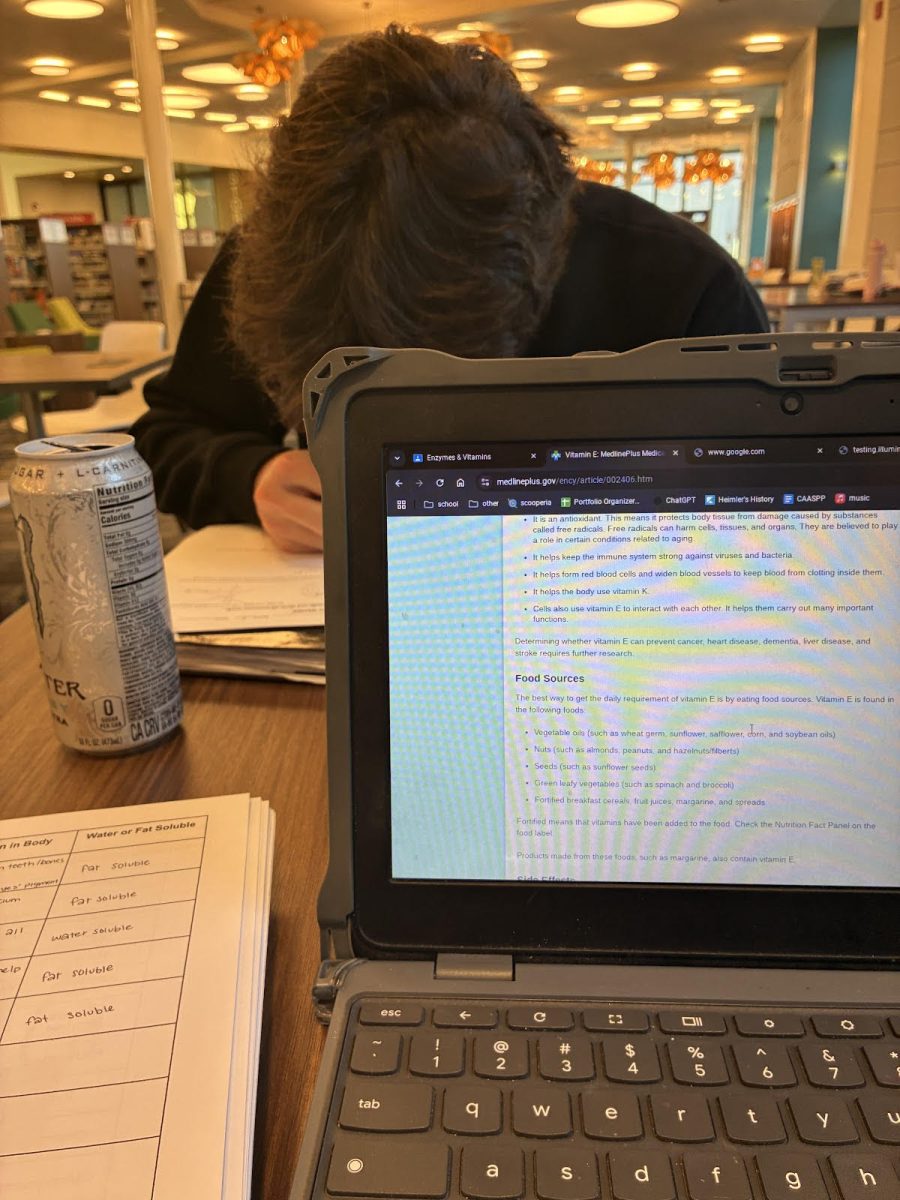


















The quiet night of Tuesday was interrupted by the thud of her head hitting the desk. Books and notes were scattered everywhere as Sophie Chen, a sophomore student, blinked open her tired eyes and sipped from her almost empty coffee cup. Sunlight shines through her window, signaling that it is already dawn. She spent her whole night finishing up her assignments, and school begins in two hours. “I’ve pulled lots of all-nighters. It doesn’t even bother me much anymore,” stated Sophie Chen (10).
For many students, high school is no longer just about learning; it has become a competition, where only the best succeed. They stack their schedules full of AP courses and extracurricular activities, constantly optimizing every minute to be productive. Amani Dhody (9) shares, “There was one day last semester when I had a huge project due, an essay in progress, and extracurricular meetings all at once. I just felt crushed by the weight of needing to be better at everything right now. I remember staring at my planner and feeling like I was failing at even breathing on time. That pressure came from everywhere: my parents’ expectations, social media, my peers, and my own inner voice, the loudest.” Even though she is just a freshman, Amani can already feel the pressure building up, catching herself trying to compete for a version of herself four years from now, instead of just enjoying her school life as a freshman.
Seeing peers accomplish so much, students often feel they will be left behind if they don’t start doing more, driving them to overachieve. When Sophie sees her peers taking multiple AP courses or participating in many extracurricular activities, she explains that she feels a pang of urgency, “telling me that while others are doing all the things, I’m just doing ‘this’. I find myself trying my best to modify my daily habits, so I have more time to do more.” While Sophie feels the pressure from her peers, other students find pressure within themselves. Amani also realized that, “If I am criticizing myself for every little mistake and never feeling like it is enough, that is when I am being too hard on myself. Honestly, that happens to me more often than I would like to admit.”
Even after students reach their goals, they hardly get the chance to rest, as the pressure for their next accomplishment immediately sets in. Sophie shared that while she does feel more secure after pushing herself so hard, the feeling never lasts, since she feels the need and pressure to start improving again.
Overachieving has become standardized in today’s society. The pressure of college applications used to affect juniors and seniors specifically, but it has now expanded onto the shoulders of freshmen and sophomores, sometimes even younger students. Sophie recounts that daily exhaustion occurred since middle school. Sophie is not alone; the CDC states that about 77% of high schoolers got insufficient sleep in 2024. This data increased significantly compared to 2013, which was 68%.
The weight of college looms over students’ heads, resulting in “the constant pressure to be perfect and achieve more,” as Amani states. With frequent all-nighters and exhaustion, Sophie finds herself sometimes sleeping the weekend away due to her chronic sleep deprivation.
One of Yorba Linda High School’s school counselors, Mrs. Gandy (S), noticed that college anxiety has become much earlier, with some students worrying about college as early as middle school. By the time they reached their freshman year, they felt that they would be behind if they did not take advanced classes. Mrs. Gandy noted that students believe burnout shows that they have worked hard enough, while “rest is often viewed as laziness rather than a necessary part of learning, growth, and mental health.” The constant striving for achievement often comes with sacrifices and emotional costs.
Students are not just trying to manage and balance their workload. They are trying to balance that on top of just being who they are. They give themselves little to no time to just be a teenager, resulting in them losing their identity. Amani described, “Sometimes it feels like I cannot just be a freshman and enjoy learning and growing naturally…It is a hard balance, wanting to improve but also remembering I am allowed to just be me right now.”
Students believe that they do not have the time to take a breath or just be themselves. They are constantly striving to improve and be a better version of themselves until they can become the epitome of perfection. However, this is a never-ending race, as they continuously push themselves to a higher level. The term “good enough” does not exist in our generation. If Sophie stops trying to improve herself for a while, she thinks that she will become a failure. However, if she continuously pushes herself, it will result in burnout.
College admissions have been quantifying students’ efforts with numbers, résumés, and comparisons, leading students to believe success comes in data and rankings. This system rewards those who take the most AP courses, participate in multiple extracurricular activities, hold several leadership titles, and achieve numerous awards. Even school counselors acknowledge the challenge of balancing a healthy lifestyle and preparing for a student’s future. “Sometimes the healthiest choice for a student does not align with what they believe college wants,” shared Mrs. Gandy. Statistics from the Pew Research Center in 2025 explained that “By far the biggest source of pressure for teens is their grades. Roughly seven-in-ten teens (68%) say they face a great deal or fair amount of pressure to get good grades.” This is illustrated by Amani and Sophie, who push themselves to stay on top of grades.
Mrs. Gandy is concerned that “[Students] begin to tie their self-worth solely to achievements. When improvement becomes endless, and satisfaction is never reached, students lose joy, curiosity, and perspective. Growth should be meaningful and sustainable–not driven by fear of falling behind or feeling like they are never enough.” Overachieving is not just a choice anymore; it has become normalized as a survival strategy. Students have been told that they have a choice, such as choosing what they love or just being themselves; however, in a world where rankings and placements judge students’ success, the results and consequences have been saying otherwise. Success, defined as college acceptance, glorifies those who have survived and endured the pressure, but it erases the invisible costs of those who burned out, fell behind, and did not reach their goals.
