























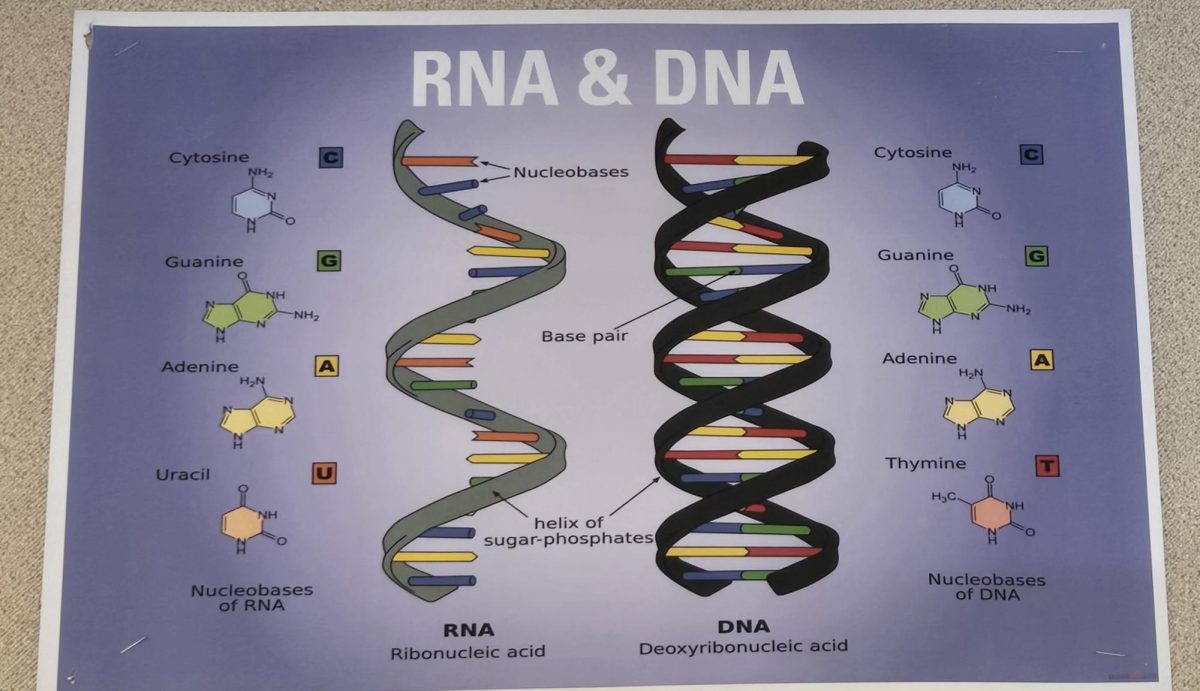
Imagine a world where there are cures to all types of diseases and disorders, ranging from sickle cell disease to Duchenne’s Muscular Dystrophy. Many lives would be saved; tragedies would be avoided. Gene editing, a technology that has become popular in the last decade, allows scientists to add, remove, or change specific DNA sequences in a living organism. This powerful tool may bring us a step closer to curing diseases deemed impossible to treat.
Gene editing, more formally known as genome editing, dates all the way back to the 1960s. In 1968, restriction enzymes were discovered, allowing DNA to be cut at a specific point. This discovery evolved into the “cut-and-splice” method. This method proved that DNA can be combined: the experiment showed two DNA strands of a virus cut and merged, forming a new strand of DNA, and sealed with DNA ligase. This process is known as recombinant DNA (rDNA). rDNA combines DNA from different organisms, which can then replicate naturally in future generations. In 1985, the discovery of the Zinc Finger Nuclease (ZFN) allowed base pairings of specific genetic sequences to be targeted. This created the opportunity to break the DNA at a specific point and repair it with recombination. This process also helped identify the exact genes causing mutations. Then, Jennifer Doudna and Emmanuelle Charpentier developed CRISPR-Cas9, which can be used to easily edit any DNA sequence at a low cost and with higher accuracy. Andrew Demartino (9) thinks, “Genetic editing will allow those with genetic diseases and disorders to potentially expand their lifespan and help them live a more normal life.”
Currently, the main types of genetic editing are CRISPR, base editing, and prime editing. CRISPR, Clustered Regularly Interspaced Short Palindromic Repeats, is a DNA editing technique used to cut the genes at a specific location and then use the DNA repair process to modify the genes. It uses the Cas9 enzyme to break the genes under the guidance of RNA. gRNA specifies the location at which Cas9 breaks the genes.
Base editing is a type of genome editing evolved from CRISPR. Instead of cutting the DNA helix strand, it edits the gene by changing the DNA base pair. The disadvantage of base editing is that it can only edit the base pairs one at a time, whereas CRISPR can edit on a larger scale. However, it has a lower risk compared to CRISPR because it is less likely to cause an error in the genetic sequence.
Prime editing is the latest technique, through which specific DNA can be located and substituted, inserted, or deleted without breaking the DNA strands. This new advance allows for higher accuracy, even lower risk, flexibility, and lower costs, making it the best evolution of CRISPR-Cas9.
The controversy involving gene editing began when a Chinese scientist, He Jiankui, edited baby embryos. He removed a gene, CCR5, in hopes of making the babies resistant to HIV. He announced the birth of the twins in a series of YouTube videos in 2018, sparking a heated discussion since many view this as unethical. Additionally, He Jiankui did not get the twins’ parental consent. Gene-edited babies are often referred to as designer babies. Many fear that with the rapid success and evolution of gene editing, people may cross the lines of nature and end up creating designer babies to make their children perfect. Instead of just avoiding hereditary diseases, they may end up editing multiple genes to increase intelligence, change appearances, etc. As Kyle Khong (11) believed, “Curing a disease is more about treating a condition; if we were to use gene editing to create super models, I believe it would strip children of their individuality before they realize it for themselves. Designer babies are not ethical, as they are transforming the natural process of creation into a chemical amalgamation towards a stunted belief of perfection.” As gene-editing technology advances, it opens up more possibilities. Individuals have different views and beliefs on designer babies; some want to create their ideal child, while others want nature to decide for them. Scientists have not yet reached a consensus on ethics.
Gene editing is still a relatively new concept with a high chance of evolving into something powerful. Scientists dream that one day they will be able to cure diseases and disorders, and they have taken the first steps already. They are attempting to treat certain diseases, and the outlook seems positive. Scientists aim to make this a one-time, affordable process that can slow down or stop a disease for a lifetime. Although these successes and technologies are still in the developmental stages, the future looks promising with all of the discoveries in gene editing.

Ashley Chavez • Jan 23, 2026 at 11:52 AM
I loved learning about gene editing through your article!
Derek Truong • Jan 22, 2026 at 7:35 AM
I learned about gene editing in my biology class, and I think it is so interesting. Thank you for revealing so much more about it!
Zach Walker • Jan 22, 2026 at 7:31 AM
I saw on the news now you can actually pick your eyes color, hair color, and even how tall they can be. I personally think that it’s too much but some people seem to be really excited about it.
Journey • Jan 22, 2026 at 7:30 AM
This was a very informative article about DNA! I can’t wait to see what’s to come for gene editing. Great article!
Cynthia Lan • Jan 22, 2026 at 7:30 AM
Kerrine’s article provides a concise overview of gene editing’s foundation (DNA bases), evolution (restriction enzymes to CRISPR), and potential (curing genetic diseases). While the ethical discussions are important to address, I believe using cost-effectiveness and accurate technology to let humans be free from genetic diseases is inspiring.
Peyton Rodriguez • Jan 22, 2026 at 7:29 AM
Wow, this is really interesting. I loved reading this article!
Ishani Bhatt • Jan 22, 2026 at 7:28 AM
Wow, so interesting! It’s crazy to think that gene editing dates back to the 1960s!