














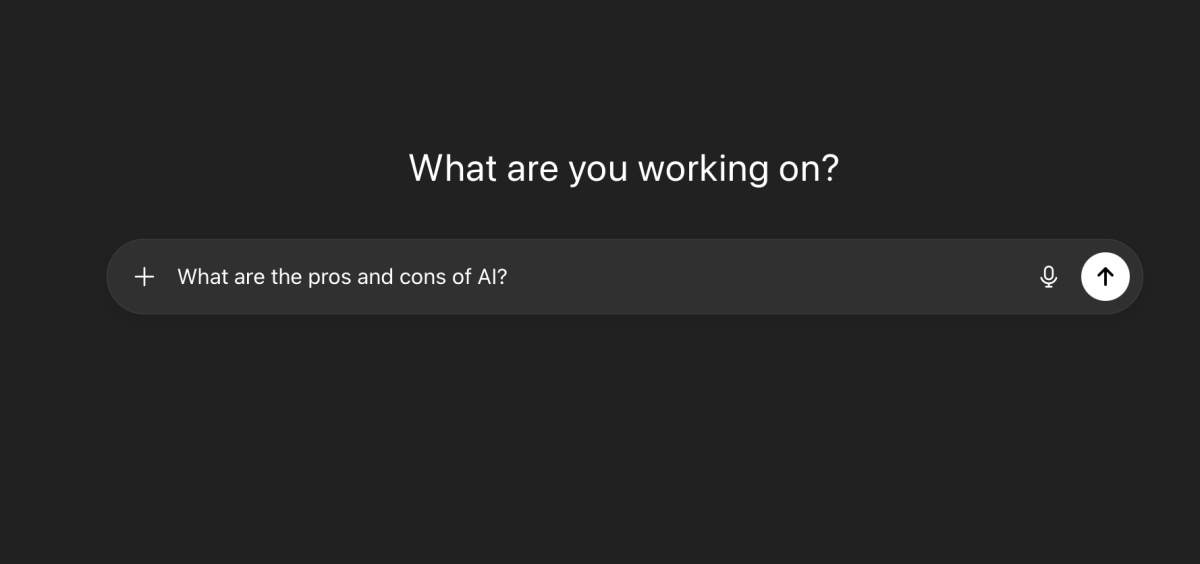
AI has become one of the most transformative technologies of our time. Its benefits are undeniable. In healthcare, AI helps doctors detect diseases faster and with greater accuracy. In education, AI tutoring platforms provide personalized feedback to students, making learning more accessible. Even in daily life, AI assists with organization and communication, saving time and increasing efficiency. From speeding up research to helping people brainstorm ideas, AI has empowered humans to achieve more than ever before. Yet, the problems start to arise when it replaces human creativity rather than inspiring it.
“The impacts of AI are definitely notable, both my friends and family use ChatGPT and other AI platforms almost everyday for a wide variety of reasons,” elaborated Grecia Chavez (12), “But I’m not sure if that is a good thing or not.”
AI programs like “IBM Watson Health” can analyze thousands of medical records in minutes, helping doctors detect cancers and other diseases much faster than traditional methods. In education, platforms such as “Knewton and Squirrel AI” provide personalized lessons that adapt to each student’s strengths and weaknesses, making learning more effective and accessible. Even in daily life, AI assistants like Siri, Alexa, and Google Assistant help people manage schedules and answer their questions instantly.
Yet Claire Kwon (11) has some concerns about AI. “Artificial Intelligence is everywhere, and frankly it’s quite alarming. Our society has become too dependent on it and we need to break free,” explained Claire Kwon (11).
AI does have a concerning dark side, particularly when it begins to replace humans or even manipulate reality. In the entertainment industry, AI-generated performers like Xania Monet, an AI R&B singer, and Tilly Norwood, a digital actor bypass years of training and experience and raise concerns about authenticity and fairness. While musicians and actors spend years mastering their craft, AI can imitate performance without feeling emotion. Beyond art, AI poses serious risks of information warfare. Tools like “Sora AI”, a text-to-video generative AI program, allow users to create realistic videos of people saying or doing things they never did. Deepfake videos can be created with Sora AI to spread false narratives by manipulating public perception and even targeting political events or public figures. While Sora includes watermarks to identify AI-generated content, these safeguards are not always consistently visible, making it easier for disinformation to circulate throughout our society.
AI is a powerful and beneficial tool that is used in many aspects of society. Although it does have great risks, sometimes it does have a great reward. As artificial intelligence grows stronger, it is important that we as a society decide how to use it responsibly. The future of AI depends on how we carefully shape it.
