


















We have all experienced moments of forgetfulness and distraction. During such moments, the first words or sounds that come out of our mouths don’t carry much meaning at all. Well, not directly at least. Though, I think we can all agree that an accurate translation for “ummmm” is “whoops, I can’t think of anything right now.”
However, as English speakers, we can make that direct association; native speakers of diverse languages around the globe would likely struggle to decipher these strange words and sounds. A simple “ummm” between sentences could be interpreted with utter confusion. The culprits of this linguistic phenomenon: geography, isolation, culture, and the human desire to belong.
How being bilingual has affected my everyday speech
Despite classes being taught in English, I have subconsciously found myself blending Spanish filler words into my everyday speech. If being in my Spanish-speaking family has taught me anything, it’s how to use “este” when my brain is processing something, or when the word for a kitchen utensil chooses to sink itself to the very pit of my memory. When I switch from English to Spanish, it’s like my brain rewires and uses filler words that are typical of their respective language.
Mrs. Yakzan (S), the French teacher at Yorba Linda High School, explains having similar experiences: “Whenever I speak a different language, it’s like I’m flipping a page. If I speak Italian, German, French, or English, I use their filler words. Because French and Italian have similar filler words, I sometimes use them interchangeably.”
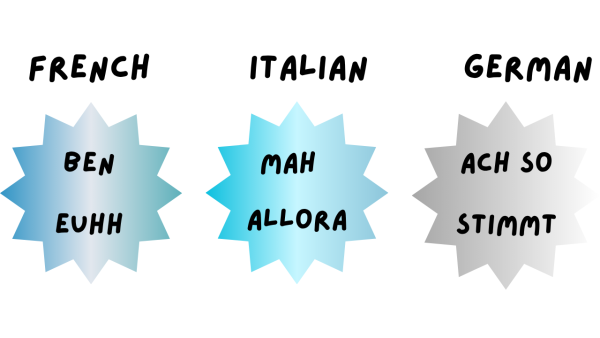
These switches happen because every language has a different “sound system.” A sound system is a set of unique sounds and speech patterns associated with a certain language. The University of Arizona conducted a case study in which bilingual individuals who learned their second language before the age of 8 were split into two groups (psychologicalscience.org). Both groups were given a variation of words and were asked to identify what sounds the words they heard began with.
The group that was told it would hear words in Spanish pronounced the words with a Spanish flair, and the group that was told it would hear words in English had an English pronunciation. Your brain switches modes the second it identifies the target language.
How filler words vary between regions
Whether North and South or East and West, differences in speech are noticeable, and occur at different levels: local, regional, and national.
Spanish-speaking countries in the Americas are a great example of linguistic variation. In Mexico, a phrase I often hear among the younger generations is “o sea,” which could be translated to “I mean” or “so.”
In Colombia, they use “vaina,” which could be translated to “thing.” An example in use is: “Esa vaina…no me acuerdo de ella,” or “That thing…I don’t remember it.” If you ever watch Colombian shows, or, like me, have Colombian friends, you will quickly notice them using this word frequently to replace forgotten words.
Although I am not personally familiar with the filler words in Asia, they have plenty of regional variation as well. Charlie Chen (11), who has lots of family in China, shares that “In everyday Chinese, people often use fillers like ‘那个’ (nà gè), ‘然后’ (rán hòu), and ‘就是’ (Jiù shì) to pause or think. Northern speakers tend to say ‘那个’ (nà gè) more, while southern speakers might use ‘然后’ (rán hòu) or ‘你知道吗’ (nǐ zhīdào ma) instead.”
Jaden Rheimer (11), who is half Japanese, shares: “Common filler words in Japanese are ‘ええと’ (eeto) and ‘あの’ (ano). I personally use ‘ええと’ (eeto) a lot more.”
These students—including myself—are a testament to the world’s linguistic variation. It’s really fascinating that some alphabets and speech customs managed to be so different when they happened nearly, if not exactly, at the same time.
Variation and its causes: an Interview with a psychologist
I had the chance to speak with Guillermo Da Silva-Montemayor, an LMFT (Licensed Marriage and Family Psychotherapist) and father of a YLHS student, who explains the phenomenon of linguistic variation: “From a psychological standpoint, speech adaptation is about feeling that you belong and gives you that sensation of safety. We are wired to fit into a social group, and adapting fillers is a part of a cultural and social identity. Learning to speak a local language can reduce the risk of being excluded, judged, or bullied.”
He notes that filler words also “serve as a psychological function to regulate thoughts, emotions, and interpersonal connections,” and to “keep in mind that fillers sometimes can reveal personality traits, status, and in group belongings.”
When asked about geographical differences as a causation, he commented the following: “Geography and group separation play a huge role on how people develop identity and speech patterns. Sociologically speaking, geographic isolation shapes identity and social pressure to conform.”
The Art Of Noticing
The likelihood that every person reading this article has noticed differences in filler words is low, so I want to take the opportunity to say: talk to more people and appreciate their culture. You never know what you are going to hear next. Whether it be at school, at work, or even at the park; America is home to many people who speak different languages. As a Californian, I can proudly say that every time I go to the supermarket, I hear several gems from around the world.
