



















As the movie K-pop Demon Hunters takes the world by storm with its incredible music and graphics, K-pop’s popularity is soaring even higher, with over 266 million views and counting on Netflix.
K-pop Demon Hunters was released on Netflix on June 20th, 2025, and many songs from its soundtrack reached the Top 10 of the Billboard Hot 100 Chart in just a few weeks. This accomplishment made it the first in almost 30 years for multiple songs from the same soundtrack to reach the Top 10 (billboard.com). The director of the film, Maggie Kang, got her inspiration for the film from her Korean-American background, wanting to make Korean culture more known globally (geekscout.org). The origin of the movie came from her interest in Korean mythology, specifically demons. This led her to the idea of incredible girls fighting demons; however, this idea itself wasn’t enough. Later, they found the missing element: K-pop. The K-pop factor completely transformed the movie, and by using K-pop’s ability to break through cultural barriers, it made the movie even more spectacular. At first, none of them expected the movie to be such a big hit. K-pop contributed to the movie’s success; ironically, the movie also helped increase K-pop’s global recognition and elevate its popularity to the next level, resulting in a mutual benefit (variety.com). So how did K-pop become so popular?
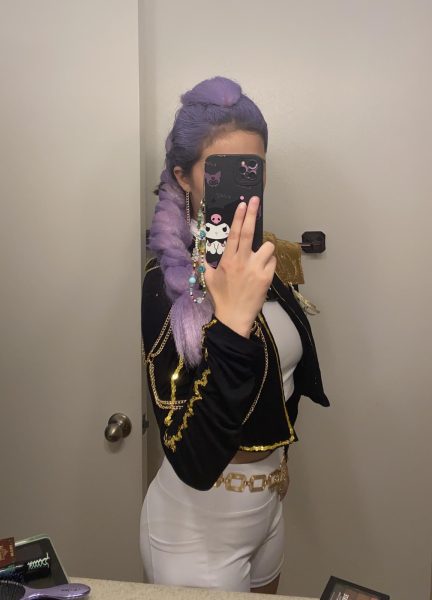
K-pop music is inspired by a mix of a variety of genres like R&B, Hip-Hop, American Pop, etc. From this, it is fused with traditional Korean music. Additionally, K-pop incorporates dance choreographies into their music, which often start many popular dance trends on social media like “Cupid” by FIFTY FIFTY, “Magnetic” by Illit, “APT.” by Rosé and Bruno Mars, and “Touch” by KATSEYE. Social media, a free promotional resource to idols, allows K-pop idols to connect with fans across the world and shapes how fans interact with them. “Social media impacted me as a K-pop fan because I see how idols and other people dance, and I see how I can improve,” states Jenny Cho (9). Platforms like TikTok, Instagram, and YouTube allow fans to participate in K-pop culture without a location barrier. With YouTube Shorts and Instagram Reels, dance challenges, memes, and reaction videos provide a catalyst for K-pop songs to take the world by storm.
According to news.colgate.edu, the rise of K-pop can be traced back to SM Entertainment. SM Entertainment wanted to target the global market instead of just Korea. They didn’t have access to mainstream platforms like radios, television stations, or Western record labels back then; however, SM focused on using the internet to gain fans worldwide.
Second-generation K-pop artists pioneered using social media to promote their groups. They often released music on YouTube along with dance practice and behind-the-scenes videos. The second generation also set the precedent of using Twitter and Instagram to post selfie pictures and interact with their fans (sojcssm.com). Many teens spend hours on social media a day; therefore, companies use that as a marketing strategy. They post the latest information, like concept pictures, album information, challenges, etc. Teens often scroll through social media, so news and advertisements spread quickly.
In 2007, Wonder Girls debuted from JYP Entertainment with 6 members. In 2008, they released the song “Nobody.” “Nobody” is a song with a retro Motown vibe and a catchy chorus. Then, they released an English version of their song around 9 months later, intended for the American market. The song became the first K-pop song to make it into the Billboard Hot 100 at number 76 (billboard.com). They were also chosen to perform at Jonas Brothers’ concert for the American leg of their tour in June 2009, which promoted their song.
Big Bang, Girl’s Generation, and 2NE1 helped pave the way for artists like BTS and Blackpink to make it into the Western market. Big Bang was the first K-pop group to have a full world tour, which helped with their international popularity. They were also the first K-pop group to win international awards, such as the 2011 MTV Europe Music Award for Best Worldwide Act and the Italian MTV award in 2016 (allkpop.com). Additionally, Girls’ Generation targeted international audiences with the song “The Boys,” and they also released English versions of their song to promote themselves in the U.S. Furthermore, 2NE1 collaborated with Western artists like Will.i.am and Apl.de.ap to help them gain fans internationally.
In 2012, PSY rose to global fame with the hit song “Gangnam Style”. With its catchy tune of “Oppan Gangnam Style” and the unique horse-riding dance, the song became viral with the music all over social media, and PSY appeared on American late-night shows. The song broke language and cultural barriers, even making it on the Billboard Hot 100. Then, it rose to number 2 in just a few weeks. Gangnam Style also set the record of being the first video to hit one billion views on YouTube (cnn.com).
When you first think of how K-pop became popular, BTS is often the first K-pop group that comes to people’s minds. BTS started gaining popularity in Korea with their releases, such as I NEED YOU, Dope, and Blood Sweat & Tears. Many of their songs often have a deeper meaning and talk about social issues. Fans started to stan BTS because they felt drawn to their music. As BTS started to gain popularity, they became the first K-pop group to attend the American Music Awards in 2017. They also presented at the Grammy Awards in 2019. The following year, they performed at the awards show with Lil Nas X for the song Old Town Road. Additionally, on May 31, 2022, BTS went to the White House to visit former President Joe Biden. BTS has an estimated 10 million fans across the world, showing how much impact they made on K-pop history (businessinsider.com).
Another important K-pop group that helped K-pop skyrocket to become known globally is Blackpink. Blackpink is the first K-pop group to reach 1 billion views with a debut song, that being “Boombayah”. The group’s debut appealed to the Western audience through their members’ nationality, music, and concepts. They have been breaking records with every comeback, and multiple songs have hit 1 million views on YouTube. Most of their soundtrack is created by Teddy Park, the songwriter behind their success, along with other groups like Big Bang and 2NE1. His music incorporates inspirations from American and Korean music, catering to audiences in the West (medium.com).
As K-pop becomes more and more globally known, groups have started incorporating more English lyrics into their songs to make their songs more well-known. K-pop music also has catchy tunes and lyrics with its simple and repetitive choruses. Fans like Leyna Mou (9) shared, “My cousin introduced K-pop to me, and ever since then, it has become one of the genres I listen to the most. Some K-pop songs have really nice lyrics and sound nice, too.”
Since K-pop is spreading more into the western region, companies like JYP and HYBE formed international K-pop groups like VCHA (now known as GIRLSET) and KATSEYE. These two groups were formed with international members using the K-pop training system. With idol group members from different countries, there would be more fans since they would be supporting the idols representing their countries. International K-pop groups are now a new marketing strategy to globalize K-pop.
Immigration is also a key to K-pop’s success. With large numbers of Koreans immigrating to the U.S., they bring their culture and music along with them. The next generation of children, exposed to both American and Korean culture, will spread K-pop to their friends. Abigail Ro (10) explained, “People brought Korean culture to America. It started with immigration. Because of relocation and diffusion, Korean culture has spread from Korea to the United States. And with the development of new technologies like social media and electronic devices like phones, it’s able to have a widespread impact on society. For example, in America, specifically L.A., the presence of Generation X immigrants from Korea has laid the foundation for these types of culture to thrive in American society. Also, Korea’s marketing techniques have improved so much with the addition of concerts and TikTok.”
As technology and marketing techniques improve, K-pop is blooming across the world. K-pop did not become a global phenomenon overnight. The timeline dates all the way back to the 1990s, and with its evolution and groups paving the way, K-pop is now known to the entire world.
