























Languages come in many forms: letters, characters, and hand motions all constitute their own meanings. Similarly, flowers, too, have their own language. Rather than different strokes, alphabets, or fingers shown to display their meanings, flowers gain meaning from their breeds, colors, and mythology.
Floriography, the symbolic and artistic use of flowers to convey a message, originates from the Victorian era, where women used flowers to convey messages without the knowledge of their guards (Interflora). In the 1800s, newspapers started publishing floral dictionaries with definitions of flowers collected over the years (Planterra Conservatory).
Besides Victorian connections, mythology also plays a part in floriography. Much like its name suggests, Narcissus derives its meaning of vanity from the tale of Narcissus, who fell in love with his reflection and died staring at it, leading to the flower blooming. Meanwhile, Hyacinth’s bittersweet meaning relates to the cycle of sorrow and loss from the tale of Apollo and Hyaccinthys, where Apollo accidentally kills his love in a game of discus (Bloom & Wild).
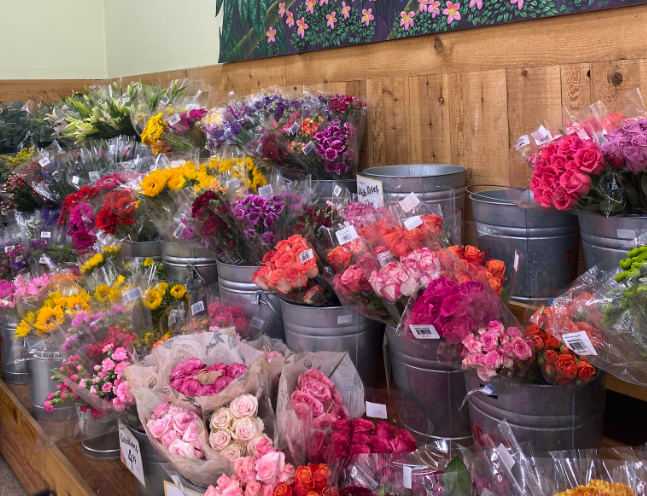
While mythology and history are greatly significant to floriography, sometimes the meanings boil down to something as simple as color. As a generalization, red flowers convey courage, passion, and true love, emotions often seen in a genuine confession. On the platonic side, yellow flowers symbolize joy, and their bright color lights up a room. Pink can represent a gentler red, often symbolizing love but in a softer sense; they are also tied to femininity, thus appearing in Mother’s Day bouquets. Similar to yellow flowers, orange flowers are used to emphasize enthusiasm and excitement for an event. White can have positive and negative connotations; often seen at weddings and funerals, it represents the purity that comes with rebirth and new beginnings (1800 Flowers).
Moving on from generalizations, how do these meanings apply to people? Flowers are often attached to different months and retain their meanings, allowing those born in those months to connect with the meaning. The meanings can also be connected to seasons and the emotions those seasons produce.
For January, while it is still fairly cold, the Snowdrop blooms through the snow. They signify hope as one of the first flowers to bloom in the year. They were also gifted from an angel to Adam and Eve following their banishment from the Garden of Eden, promising hope for their future in civilization. These flowers are associated with genuineness, loyalty, and being down-to-earth.
February is connected to the Violet as their deep purple matches the Amethyst, February’s birthstone. Both are also associated with deep love, as the Violet’s heart shape led to its use in love potions. Connecting back to the Victorian age, the flowers were a sign of loyalty and are now associated with compassion in people.
March’s flower is the Daffodil, or in Latin, Narcissus, the flower from the myth. While it is a sign of good fortune, gifting a single Daffodil represents misfortune, so a large bouquet is the way to go. Matching its yellow hue, those born in March are often seen as optimistic and energetic.
April has a classic daisy, representing purity and bliss. The name is derived from an Old English phrase “daes eage,” or day’s eye, referring to the flower’s tendency to open in sunlight. The daisy is tied to loyalty and a down-to-earth nature.
Reaching the peak of spring, May’s birthflower is the Lily of the Valley. While it only blooms for a short period, it is a symbol of hope and, in Victorian times, was seen as a return to happiness. They are associated with Eve as they were said to bloom from her tears as she left the Garden of Eden. Also called May bells, they are associated with humility and tenderness.
Going into Summer, June is given the Rose. A classic symbol of passion and love, their meanings can actually be quite different from their colors and abundance given. Reds have romantic connotations, while yellows or oranges have more platonic connotations. In abundance, roses signify great gratitude. As expected, those born in June are likely to be passionate and graceful.
Floating in the middle of the year, July’s birthflower is the flower known for floating on water, the Lotus. As they grow in unconventional places, they are seen as symbols of positivity; this is further pushed as they can grow in the dirtiest of waters and produce great beauty. As such, those born in July match their birthflower as resilient, wise, and high-achieving people.
For August, the birthflower is the Poppy, which represents peace and strength. Much like the Rose, their meaning highly depends on the color, but it still has positive connotations. Matching the flower’s ability to self-seed, those born in August are noted for their strength of character and creativity.
Entering the colder seasons, September’s birthflower is the morning glory. As their name suggests, they bloom in the morning and close as the day continues. Being resilient flowers, they pass their traits to those born in the month, as September-born people are seen as optimistic and imaginative.
Named for their perfectly-placed petals, Cosmos are the birthflower of October. The name was given to them by Spanish priests and is now seen as a very reassuring gift. The etymology behind their name can be traced to the Greek word kosmos, meaning order and harmony. Thus, those born in October are seen as balanced and at peace.
Native to Asia, November is associated with the Chrysanthemum. Significant to Asian history, Japan has its own festival dedicated to the flower called the “Festival of Happiness.” Known for its golden shine, the flower actually blooms in red and white, which signify different meanings. The personality traits connected to this month and flower are compassion and honesty.
Matching the chilly season, December’s birthflower is the holly berry. As their prickly leaves are used as a defense mechanism, the flower represents protection, and its connection with the holiday season allows it to symbolize joy as well. So, those born in December are often joyful and resilient (Simple and Dainty).
Overall, flowers hold meaning to culture and history, and especially on a personal level. As Krishaa Seth (11) can vouch, “Flowers are beautiful, and by gifting them to someone, you show gratitude and fondness for that person. They are special to me because my mom loves flowers, so her affection for them has been instilled in me.”
Gifting them to another person can be a memory that lasts forever. Gavin Esqueda (11), who still has the two flowers he has received, admits, ”I think flowers are such a simple yet powerful show of care and thought. The idea of someone seeing something as pretty as a flower and then thinking about you and how you should have it is such a sweet concept that I really love about flower giving.”
In essence, the $5 bouquet in the grocery store may seem like a throw-away purchase, but in reality, it can be the memory of a lifetime. They signify consideration, care, and compassion. So, the next birthday, happy time, or need to express gratitude is the perfect chance to impact loved ones with a simple bouquet that speaks in florals.
