















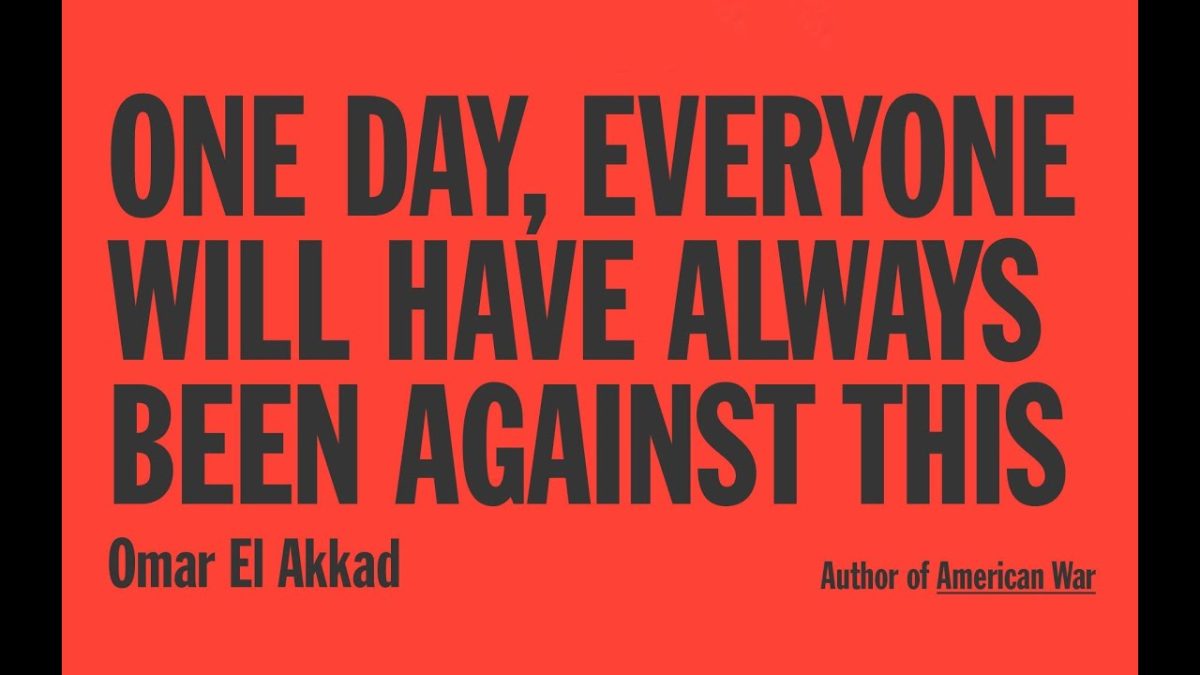
In a chaotic world where headlines flash and fade in the blink of a second, Omar El Akkad’s One Day, Everyone Will Have Always Been Against This offers a time to pause, reflect, and recognize that forgetting is not passive—it is deliberate. This collection of essays is a quiet fire that burns through the illusions of neutrality—one that does not aim to comfort but invites us to witness.
El Akkad, a journalist and Egyptian-born immigrant to Canada, reflects on the weight of physical and emotional borders. He reflects on refugee experiences, systemic racism, and climate collapse. He writes as both a father and a son. As someone who has also crossed oceans and expectations, reading his words, I felt the pages turn inward.
Like El Akkad, I am also a son and an immigrant. Though my path is different, I know what it means to straddle two worlds—to feel the quiet ache of leaving one behind and the pressure of earning a place in the other. A second-generation immigrant to Canada, Jackie Zha (10) states, “I often find myself caught between two worlds—never fully belonging to either. I’m too Chinese to be considered truly American, yet too American to feel completely Chinese. It is a constant struggle of identity, like living in the in-between.” When El Akkad writes about the silence between a father and son, or the strange sense of invisibility in a new country, it doesn’t feel like an essay—it feels like something I have carried.
The title—One Day, Everyone Will Have Always Been Against This— says everything. It captures how societies try to change the scope of atrocities and pretend they were never complicit. Sophie Yang (10) thinks that “it’s so disturbing to realize that the truth isn’t what always survives, but is what is allowed to survive, but even silence leaves fingerprints.” El Akkad explores this theme of historical revisionism with nuance, showing how memory is not just what we carry but what we are allowed to carry.
Standout essays include a meditation on Palestinian identity, a piece on the racial profiling he experienced as a journalist in the U.S., and a personal remembrance of his father’s passing. Instead of calling this piece a collection of essays, it is simply a collection of words that thread one into the other with force, painting a picture of a world where erasure is routine and grief is political.
This book is not for those looking for clean resolutions or feel-good takeaways. Still, if you are willing to sit with discomfort, One Day, Everyone Will Have Always Been Against This offers something much more powerful: perspective, humanity, and a reminder that the most dangerous thing we can do is forget.
