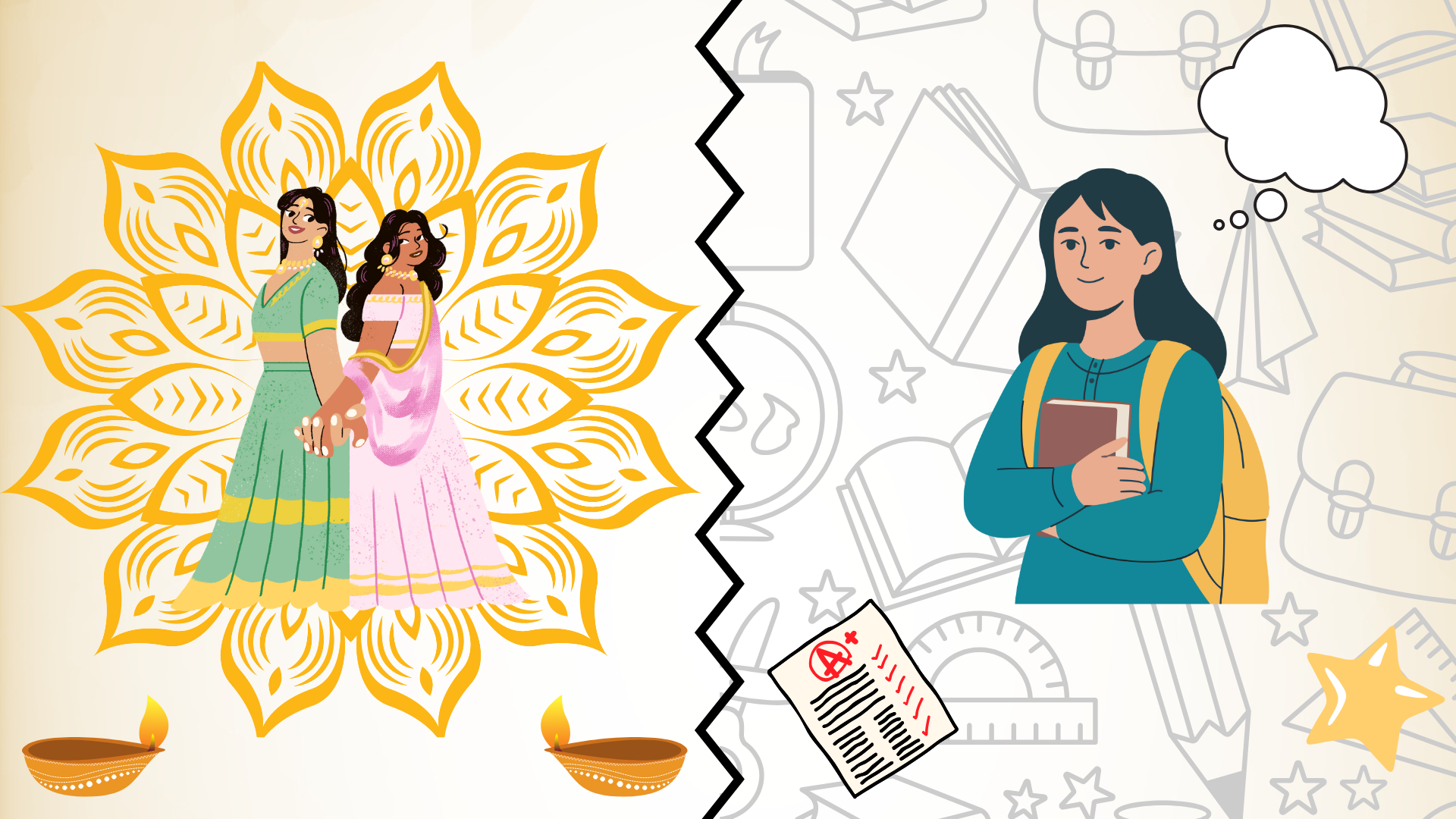

At school, when talking about my parents I say, “My mom and dad.”
At home, I say, “Na amma mariyo nanna.”
Sometimes, I accidentally mix them up without realizing it, a collision of my two worlds that somehow belong to me.
It is easy to think of language and our character as fixed, something rooted in place. But for many of us, it changes depending on where we are, who we are with and how safe I feel to be myself. There’s a term for that very occurrence: code-switching.
It’s what happens when you switch between English and your mother tongue mid-sentence or when you adjust your accent, words, or tone just enough so others would understand you. To some, it may seem confusing, like my identity is tangled and lost. But to me, it’s the way I make myself heard, the way I make sure I belong, even in spaces that might not fully understand or even want me there.
And I’m not alone. Research shows that nearly all bilingual and multilingual individuals engage in daily life, usually subconsciously. In one international study, 70% of students said they mix languages when speaking, and 85% said they do it to express themselves more clearly (ISSH Viewpoint). What might look like confusion to some is, in truth, an act of balancing identity and belonging.
I’ve been code-switching since as long as I can remember. I didn’t even realize I was doing it at first. I would sit at the lunch table, quietly pushing my lunchbox of curry to the side, pretending I wasn’t hungry, pretending to know what my friends were laughing about that day, I’d nod along and agree to conversations that felt like they were speaking another language, even when they were in English. But then, I’d come home, to the sound and smell of my mom cooking, my dad talking loudly to family overseas, my brother doing his homework, blasting music. I’d eat the same curry I hid at school, laughing loudly amongst my family, unworried of the fact that I had to hide who I was to fit in.
It was then that I realized what code-switching was and that there are two forms of it.
The first is linguistic: when multilingual speakers move between languages in a single thought process, like flipping a switch mid-sentence. In my household, it can be heard constantly. It happens when my brother tries to explain why his homework is late while simultaneously talking to his friend on the phone, mixing both the native language and English. Our house seems to hum with two languages simultaneously, clashing, overlapping, and bounding off the walls heavy with sound and warmth. To an outsider, it might seem chaotic, too much noise, too much emotion, but to me, it’s the music I’ve heard all my life, the music of belonging.
The second type of code-switching is quieter, and oftentimes unnoticeable. It doesn’t always sound like switching languages; sometimes, it feels like switching masks. It’s when you hide a part of yourself to make space for the version of you that the world understands. At school, this might mean flattening your accent, softening your laughter, or pretending you do not know the taste of curry that lingers in your lunchbox. I eat my food quietly; afraid someone will notice the smell of spices and wrinkle their nose. It’s not a shame, well not exactly, it’s the fear of standing out in a room where being one with the crowd seems much safer than being laughed at. But at home, it’s the opposite; you can roll your r’s again, your words can stretch back into rhythm, and you can exhale and finally take off the mask of the persona you were for several hours. At home, my voice grows louder. My laughter returns. I exist differently.
My friend, Angela Zhou (11), told me her experience of what it’s like being a multilingual speaker and code-switching from school to home. “It’s like living with two playlists in your head, one for outside, and one for home.” I knew exactly what she meant. Every conversation, every greeting, even silence, feels like adjusting the volume, switching tracks between who I am and who I need to be.
Another one of my classmates, Kavini Vinayagamoorthy (10), shared something personal with her experience of code-switching multilingually. She said, “Sometimes I feel like I’m translating myself, not my words. I deeply understood that. Your emotions, identity and sense of belonging are constantly changed in a way so that others can read you and relate to you. It can be exhausting trying to convey how you’re feeling in a way that gets people to understand you, not pushing the boundary of being judged. Research also backs that up: one study found that students who code switch often feel pressure to “translate” their identity to match their environment, attempting to balance the expectations of their own cultural worlds (EPASR Journal).
Now, some people think that code-switching is about hiding. However, for many of us, it is about making it through and, at times, finding ways to thrive in a world that sometimes only understands the stereotypes or the one version of us. For me, language is who I am. I switch not because I’m unsure of who I am, I switch because there are multiple versions of myself that deserve to be seen.
Still, there are days when switching feels heavy. Days when I pause before speaking, afraid that my words might sound too foreign, or when I forget a phrase in my native tongue and feel a small ache, like losing something of unmeasurable value: my heritage. Often, I seem to ask myself, “Am I losing my roots,” when I forget words in my native language or when I compare myself to other girls my age doing things that seem more culturally in touch to my culture. The answer to that is always unclear to me. Am I really losing a part of me when I forget certain words, or when I feel that I need to hide my culture?
I once asked the question to my aunt. What she said to me, I will never forget. She smiled, a smile that conveyed understanding. “You’re not losing anything,” she said gently. “You’re just finding yourself and learning how to carry every part of you wherever you go.”
Maybe that’s what code-switching really is, not a covering, but a blending. Our identities always seem to be adapting, shifting, and evolving.
So, when I say, “mom and dad,” and then “Na amma mariyo nanna,” I’m standing in the middle, a representation of my cultural identity. And in that space, I am whole.